Pages

Sunday, September 20, 2020

QUESTION BANK

QUESTION BANK

All the questions below carry 10 marks each.

1.       What do you understand by Mission Statement? Discuss the elements of a Mission Statement in brief. (10)

2.       Explain the term Environment in relation to an organization. Also explain the factors of internal and external environment of an organization. (10)

3.       What is SWOT analysis? Also discuss its usefulness in an organization. (10)

4.       Explain the usefulness of SWOT Analysis in today’s competitive scenario. (10)

5.       Explain the dynamics of external environment (PESTLE ANALYSIS). (10)

6.       Explain grand strategy matrix, a tool for situational analysis with a neat pictographic presentation. (10)

7.       Discuss Boston consultancy Group (BCG) Matrix of corporate portfolio analysis with neat diagram. (10)

8.       Define Mission. Describe the components and importance of mission. (10)

9.       Explain in detail about adaptive search and intuition search. (10)

10.   What is the significance of expansion for an organization? Explain the various expansion strategies in detail.(10)

All the questions below carry 5 marks each.

1.       Explain Boston Consulting Group (BCG) Matrix. (5)

2.        What do you understand by corporate level strategies? Explain in brief difference between Expansion and Retrenchment strategy. (5)

3.        Discuss McKinsey’s 7S Framework. (5)

4.        Discuss Integration Strategy. Also discuss in brief types of Integration Strategies. (5)

5.       Explain SPACE Matrix. (5)

6.       What do you understand by Diversification Strategy? Also sight difference between Concentric and Conglomerate (unrelated) diversification. (5)

7.        What do you mean by Strategic Business Unit (SBU)? (5)

8.       Sight the difference between Backward Integration and Forward Integration. (5)

9.       Discuss the concept of external environment with relevant examples. (5)

10.   List and give a brief on the various approaches to developing strategies. (5)

11.   “The Seven-S frame work provides insight into an organisation’s working and help in formulating plans for improvement”. In the light of the statement, explain McKINSEY’s framework with the help of a diagram. (5)

12.   Discuss Boston Consultancy Group (BCG) matrix of corporate portfolio analysis. (5)

13.   Throw light on Internal Factor Evaluation matrix (IFE matrix) displaying a table of strength and weaknesses of an individual hotel property. (5)

14.   Draw a model for strategic review and evaluation. (5)

15.    How do policies play a vital role in the day-to-day operations of hotel industry? (5)

16.   Describe five expansion strategies adopted by companies, listing an example for each. (5)

17.   Explain BCG (Boston Consultancy Group) Matrix in detail with diagram. (5)

18.   Describe Competitive Profile Matrix in detail giving example from hospitality industry. (5)

19.   Discuss Mckinsey 7-S framework with the help of diagram and examples. (5)

20.   Explain SWOT analysis with special emphasis on P.E.S.T. analysis. (5)

21.   How do policies play a vital role in day-to-day operations of hospitality sector? (5)

22.    List the elements of a well drafted mission statement and give a brief discussion. (5)

23.   State the various approaches for developing strategies. (5)

24.   With the help of a neat diagram, explain McKinsey’s 7S framework in detail. (5)

25.   Explain Boston Consulting Group (BCG) Matrix. (5)

26.   What do you understand by corporate level strategies?(5)

27.    Explain in brief difference between Expansion and Retrenchment strategy. (5)

28.   Discuss McKinsey’s 7S Framework. (5)

29.   Discuss Integration Strategy. Also discuss in brief types of Integration Strategies.(5)

30.    Explain SPACE Matrix. (5)

31.    What do you understand by Diversification Strategy? Also sight difference between Concentric and Conglomerate (unrelated) diversification. (5)

32.   What do you mean by Strategic Business Unit (SBU)? (5)

33.    Sight the difference between Backward Integration and Forward Integration. (5)

WRITE SHORT NOTES ON THE FOLLOWING (2 1/2 MARKS EACH)

1.       Joint Venture

2.       Stability Strategy

3.       Liquidation

4.       Product Development

5.       Conglomerate diversification

6.       Forward integration

7.       Product development

8.       Market penetration

9.       Liquidation

10.    Divestiture

11.   PLC (Product Life Cycle)

12.   Retrenchment strategies

13.   Differentiate between the following

a.        Vision and Mission

b.      Merger and Takeover

c.       Autocratic and Democratic leadership

d.      Concentric and Conglomerate Diversification

14.   Importance of objectives

15.   SWOT analysis

16.   Leadership grid

17.   Diversification

Saturday, September 19, 2020

Unit 3 - Strategy Formulation

 Introduction

Strategy Formulation is an analytical process of selection of the best suitable course of action to meet the organizational objectives and vision. 

It is one of the steps of the strategic management process.

 The strategic plan allows an organization to examine its resources, provides a financial plan and establishes the most appropriate action plan for increasing profits.

Strategy Alternatives

Typically, when a company's management or its investors think that the firm needs to restructure itself in a radical way, it will announce it's looking for alternatives.

To attain superior profitability, the firm seeks to develop a competitive advantage over its rivals.

 A competitive advantage can be based on cost or differentiation. 

There are four generic strategies from which the firm can choose i.e. Stability, Expansion, Retrenchment or Combination Strategies.

Stability Strategy

Stability Strategy is a corporate strategy where a company concentrates on maintaining its current market position. 

A company that adopts such an approach focuses on its existing product and market.

 A few examples of this strategy are offering the same products to the same clients, not introducing new products, maintaining market share, and more.

Usually, a company that is satisfied with its current market share or position uses such a strategy. Also, a company following this strategy does not need any additional resources and work using the existing expertise of the workforce.

Stability Strategy can be of three types:


NO-CHANGE STRATEGY

  • A no change strategy is a decision to do nothing new.
  • A firm adopts this strategy when their internal and external environment is stable.
  • Small and medium firms adopt this sort of strategy.

PROFIT  STRATEGY

A profit strategy is one that capitalizes on a situation in which old and obsolete product or technology is being replaced by a new one. 

This type of strategy does not require new investment, so it is not a growth strategy. 

Firms adopting this strategy decide to follow the same technology, at least partially, while transiting into new technological domains. 

Strategists in these firms reason that the huge number of product based on older technologies on the market would create an aftermarket for spare parts that would last for years. 

PAUSE/PROCEED WITH CAUTION  STRATEGY

A company adopts such a strategy if, in the past, it has enjoyed rapid growth. 

By using this strategy, the company wants to take some rest before pushing for growth again. 

Or, we can say, a company moves cautiously for sometime before pursuing growth. It is a temporary strategy. 

A company can use the rest period to make its production more efficient to exploit future opportunities.

Expansion Strategy

The Expansion Strategy is adopted by an organization when it attempts to achieve a high growth as compared to its past achievements. 

In other words, when a firm aims to grow considerably by broadening the scope of one of its business operations in the perspective of customer groups, customer functions and technology alternatives, either individually or jointly, then it follows the Expansion Strategy. 

The reasons for the expansion could be survival, higher profits, increased prestige, economies of scale, larger market share, social benefits, etc. 

The expansion strategy is adopted by those firms who have managers with a high degree of achievement and recognition. 

Their aim is to grow, irrespective of the risk and the hurdles coming in the way.

The firm can follow either of the five expansion strategies to accomplish its objectives:


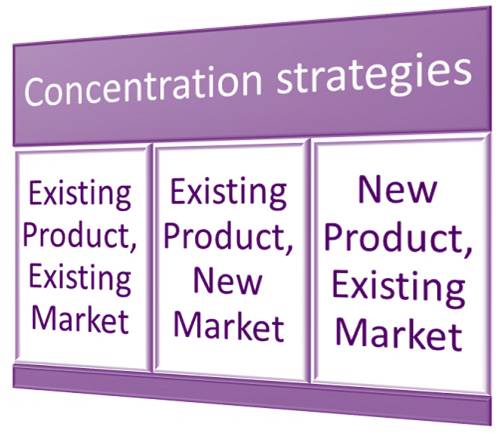
Concentration Strategy

The Expansion through Concentration is the first level form of Expansion strategy that involves the investment of resources in the product line, catering to the needs of the identified market with the help of proven and tested technology.

The organization may follow any of the ways to practice Expansion through concentration:


Market penetration strategy: The firm focusing intensely on the existing market with its present product.

Market Development type of concentration: Attracting new customers for the existing product.

E.g.  Athletic brands such as Adidas and Nike, continue to expand their global reach and attract new demographics of customers with their existing footwear products.

Product Development type of Concentration: Introducing new products in the existing market.

E.g. Mobile phone companies introducing new brands in the existing market.

Expansion through Integration

The Expansion through Integration means combining one or more present operation of the business with no change in the customer groups. This combination can be done through a value chain.

The value chain comprises of interlinked activities performed by an organization right from the procurement of raw materials to the marketing of finished goods. Thus, a firm may move up or down the value chain to focus more comprehensively on the needs of the existing customers.

The expansion through integration widens the scope of the business and thus considered as the grand expansion strategy. There are two ways of integration:


Vertical integration: The vertical integration is of two types: forward and backward. When an organization moves close to the ultimate customers, i.e. facilitate the sale of the finished goods is said to have made a forward integration. Example, the manufacturing firm open up its retail outlet.

Whereas, if the organization retreats to the source of raw materials, is said to have made a backward integration. Example, the shoe company manufactures its own raw material such as leather through its subsidiary firm.

Horizontal Integration: A firm is said to have made a horizontal integration when it takes over the same kind of product with similar marketing and production levels. Example, the pharmaceutical company takes over its rival pharmaceutical company.

Expansion through Diversification

The Expansion through Diversification is followed when an organization aims at changing the business definition, i.e. either developing a new product or expanding into a new market, either individually or jointly. 

A firm adopts the expansion through diversification strategy, to prepare itself to overcome the economic downturns.

Generally, the diversification is made to set off the losses of one business with the profits of the other; that may have got affected due to the adverse market conditions. 

There are mainly two types of diversification strategies undertaken by the organization:


Concentric Diversification: When an organization acquires or develops a new product or service that are closely related to the organization’s existing range of products and services is called as a concentric diversification. 

For example, the shoe manufacturing company may acquire the leather manufacturing company with a view to entering into the new consumer markets and escalate sales.

Conglomerate Diversification: When an organization expands itself into different areas, whether related or unrelated to its core business is called as a conglomerate diversification. 

Simply, conglomerate diversification is when the firm acquires or develops the product and services that may or may not be related to the existing range of product and services.

Generally, the firm follows this type of diversification through a merger or takeover or if the company wants to expand to cover the distinct market segments. TATA is the best example of conglomerate diversification.

Expansion through Cooperation

The Expansion through Cooperation is a strategy followed when an organization enters into a mutual agreement with the competitor to carry out the business operations and compete with one another at the same time, with the objective to expand the market potential.

The expansion through cooperation can be done by following any of the strategies as explained below:


Merger: The merger is the combination of two or more firms wherein one acquires the assets and liabilities of the other in the exchange of cash or shares, or both the organizations get dissolved, and a new organization came into the existence.

The firm that acquires another is said to have made an acquisition, whereas, for the other firm that gets acquired, it is a merger.

Takeover: Takeover strategy is the other method of expansion through cooperation. In this, one firm acquires the other in such a way, that it becomes responsible for all the acquired firm’s operations.

The takeovers can either be friendly or hostile. In the former, both the companies agree for a takeover and feels it is beneficial for both. 

However, in the case of a hostile takeover, a firm tries to take on the operations of the other firm forcefully either known or unknown to the target firm.

Joint Venture: Under the joint venture, both the firms agree to combine and carry out the business operations jointly. 

The joint venture is generally done, to capitalize the strengths of both the firms. 

The joint ventures are usually temporary; that lasts till the particular task is accomplished.

Strategic Alliance: Under this strategy of expansion through cooperation, the firms unite or combine to perform a set of business operations, but function independently and pursue the individualized goals. Generally, the strategic alliance is formed to capitalize on the expertise in technology or manpower of either of the firm.

Thus, a firm can adopt either of the cooperation strategies depending on the nature of business line it deals in and the pursued objectives.

Expansion through Internationalization

The Expansion through Internationalization is the strategy followed by an organization when it aims to expand beyond the national market. The need for the Expansion through Internationalization arises when an organization has explored all the potential to expand domestically and look for the expansion opportunities beyond the national boundaries.

But however, going global is not an easy task, the organization has to comply with the stringent benchmarks of price, quality and timely delivery of goods and services, that may vary from country to country.

The expansion through internationalization could be done by adopting either of the following strategies:


International Strategy: The firms adopt an international strategy to create value by offering those products and services to the foreign markets where these are not available. 

This can be done, by practicing a tight control over the operations in the overseas and providing the standardized products with little or no differentiation.

Multidomestic Strategy: Under this strategy, the multi-domestic firms offer the customized products and services that match the local conditions operating in the foreign markets.

Obviously, this could be a costly affair because the research and development, production and marketing are to be done keeping in mind the local conditions prevailing in different countries.

Global Strategy: The global firms rely on low-cost structure and offer those products and services to the selected foreign markets in which they have the expertise.

Thus, a standardized product or service is offered to the selected countries around the world.

Transnational Strategy: Under this strategy, the firms adopt the combined approach of multi-domestic and global strategy. 

The firms rely on both the low-cost structure and the local responsiveness i.e. according to the local conditions. 

Thus, a firm offers its standardized products and services and at the same time makes sure that it is in line with the local conditions prevailing in the country, where it is operating.

So, in order to globalize, the firm should assess the international environment first, and then should evaluate its own capabilities and plan the strategies accordingly to enter into the foreign markets.

Retrenchment Strategy

The Retrenchment Strategy is adopted when an organization aims at reducing its one or more business operations with the view to cut expenses and reach to a more stable financial position.

The firm can either restructure its business operations or discontinue it, so as to revitalize its financial position. There are three types of Retrenchment Strategies:


The Turnaround Strategy is a retrenchment strategy followed by an organization when it feels that the decision made earlier is wrong and needs to be undone before it damages the profitability of the company.

Simply, turnaround strategy is backing out or retreating from the decision wrongly made earlier and transforming from a loss making company to a profit making company.

Retrenchment Strategy

When should the firm should adopt the turnaround strategy? Following are certain indicators which make it mandatory for a firm to adopt this strategy for its survival. These are:

  • Continuous losses
  • Poor management
  • Wrong corporate strategies
  • Persistent negative cash flows
  • High employee attrition rate
  • Poor quality of functional management
  • Declining market share
  • Uncompetitive products and services

Also, the need for a turnaround strategy arises because of the changes in the external environment  E.g., change in the government policies, saturated demand for the product, a threat from the substitute products, changes in the tastes and preferences of the customers, etc.

Divestment Strategy: is another form of retrenchment that includes the downsizing of the scope of the business. The firm is said to have followed the divestment strategy, when it sells or liquidates a portion of a business or one or more of its strategic business units or a major division, with the objective to revive its financial position.

The divestment is the opposite of investment; wherein the firm sells the portion of the business to realize cash and pay off its debt. Also, the firms follow the divestment strategy to shut down its less profitable division and allocate its resources to a more profitable one.

Liquidation Strategy:  is the most unpleasant strategy adopted by the organization that includes selling off its assets and the final closure or winding up of the business operations.

It is the most crucial and the last resort to retrenchment since it involves serious consequences such as a sense of failure, loss of future opportunities, spoiled market image, loss of employment for employees, etc.

Combination Strategy

The Combination Strategy means making the use of other grand strategies (stability, expansion or retrenchment) simultaneously. Simply, the combination of any grand strategy used by an organization in different businesses at the same time or in the same business at different times with an aim to improve its efficiency is called as a combination strategy.

Such strategy is followed when an organization is large and complex and consists of several businesses that lie in different industries, serving different purposes. 

A baby diaper manufacturing company augments its offering of diapers for the babies to have a wide range of its products (Stability) and at the same time, it also manufactures the diapers for old age people, thereby covering the other market segment (Expansion). In order to focus more on the diapers division, the company plans to shut down its baby wipes division and allocate its resources to the most profitable division (Retrenchment).

In the above example, the company is following all the three grand strategies with the objective of improving its performance. 

The strategist has to be very careful while selecting the combination strategy because it includes the scrutiny of the environment and the challenges each business operation faces. 

The Combination strategy can be followed either simultaneously or in the sequence.

Wednesday, August 26, 2020

UNIT 2 - ENVIRONMENTAL AND INTERNAL RESOURCE ANALYSIS

ENVIRONMENTAL AND INTERNAL RESOURCE ANALYSIS

• Environmental analysis is a strategic tool.

• It is a process to identify all the external and internal elements, which can affect the

organization's performance.

• The analysis entails assessing the level of threat or opportunity that might present along with strength and weakness of organization.

• Environmental scanning is necessary because there are rapid changes taking place in the environment that has a great impact on the working of the business firm.

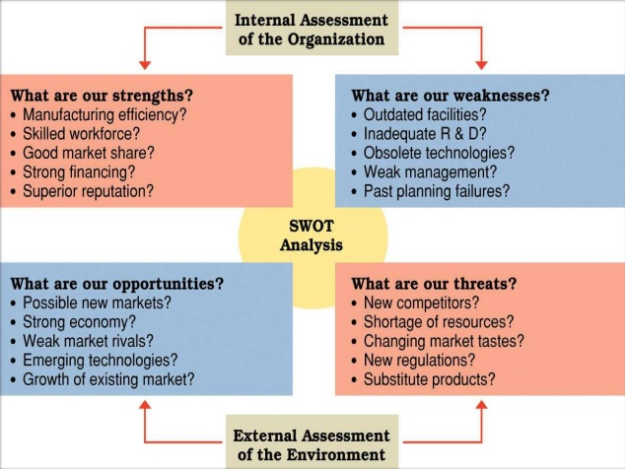
• Analysis of business environment helps to identify strength, weakness, opportunities and threats.

• SWOT analysis is necessary for the survival and growth of every business enterprise.

Environmental Scanning - Internal & External Analysis

 Internal & External Factors

Organizational environment consists of both external and internal factors.

Environment must be scanned so as to determine development

and forecasts of factors that will influence organizational success.

Environmental scanning refers to possession and utilization of information about occasions, patterns, trends, and relationships within an organization’s internal and external environment.

It helps the managers to decide the future path of the organization.


  Identification of strength

Strength of the business firm means capacity of the firm to gain advantage over its competitors.

Analysis of internal business environment helps to identify strength of the firm.

After identifying the strength, the firm must try to consolidate or maximise its strength by further improvement in its existing plans, policies and resources.

  Identification of weakness

Weakness of the firm means limitations of the firm.

Monitoring internal environment helps to identify not only the strength but also the weakness of the firm.

A firm may be strong in certain areas but may be weak in some other areas.

For further growth and expansion, the weakness should be identified so as to correct them as soon as possible.

   Identification of opportunities

Environmental analyses helps to identify the opportunities in the market.

The firm should make every possible effort to grab the opportunities as and when they come.

   Identification of threat

Business is subject to threat from competitors and various factors.

Environmental analyses help them to identify threat from the external environment.

Early identification of threat is always beneficial as it helps to diffuse off some threat.

   Optimum use of resources

Proper environmental assessment helps to make optimum utilization of scare human, natural and capital resources.

Systematic analyses of business environment helps the firm to reduce wastage and make optimum use of available resources, without understanding the internal and external environment resources cannot be used in an effective manner.

   Survival and growth

Systematic analyses of business environment help the firm to maximise their strength, minimise the weakness, grab the opportunities and diffuse threats.

This enables the firm to survive and grow in the competitive business world.

   To plan long-term business strategy

A business organisation has short term and long-term objectives.

Proper analyses of environmental factors help the business firm to frame plans and policies that could help in easy accomplishment of those organisational objectives.

Without undertaking environmental scanning, the firm cannot develop a strategy for business success.

 Environmental scanning aids decision- making

Decision-making is a process of selecting the best alternative from among various available alternatives.

An environmental analysis is an extremely important tool in understanding and decision making in all situation of the business.

Success of the firm depends upon the precise decision making ability.

Study of environmental analyses enables the firm to select best option for the success and growth of the firm.

 KEY ENVIRONMENTAL VARIABLE FACTORS

The marketing environmental variables include all those factors which are external to a firm and which affect the decision-making process.

A company’ s marketing executives must constantly monitor the changing marketing scene and observe the changing environment through marketing research and first-hand knowledge.

The environmental variables can be divided into Micro-Environment Variables and

Macro-Environment Variables

The variables in the company’s micro- environment include:

(1) Supplier,

(2) Marketing intermediates,

(3) Customers,

(4) Competitors, and

(5) Public.


1. Suppliers:

In a broad sense, they supply the resources to a company. So, they must be operating efficiently if the marketing manager has to succeed. Any shortage of supply or price hike or strike affects the marketing function. The firm, thus, should avoid dependence on any single supplier.

2. Marketing Intermediates:

They are the middlemen who create place utility, time utility and quantity utility. They also include physical distribution firms, transport companies, marketing consulting firms, marketing services agencies and assist the company in targeting and promoting the right products to the right markets. Banks and insurance companies as the financial intermediaries also assist in selling goods.

  3. Customers:

They refer to consumer markets, industrial markets, reseller markets, government markets, and international markets. Each market has its own characteristics.

4. Competitors:

They have great influence over the firm. Their activities and programmes are needed to be studied very carefully for the purpose of the determination of marketing position of a firm

5. Public:

This refers to public relations, government policies, the press, the legislators and the general public. The marketing decisions of a firm are considerably influenced by these farces and elements.

The study and analysis of the micro-environment and its variables are, therefore, very important for an appreciation of the marketing concept.

MACRO VARIABLES

The variables in the company’s macro-environment include:

(1) Demographic factors

(2) Economic factors

(3) Natural factors

(4) Technological factors

(5) Political factors

(6) Cultural factors


1. Demographic environment:

It includes such factors as population growth, change in age-group, marriages, family sizes, movement of people from big cities to rural or suburban areas, white collar population, literacy, etc.

2. Economic environment:

It refers to gross national product (GNP), per capita income, disposable income, discretionary income, distribution of income, inflation, savings, liquid assets, changes in consumer expenditure, etc.

3. Physical environment:

It includes pollution and environmentalism, wastage of natural resources, etc.

4. Technological environment:

It emphasises the accelerated pace of technological changes, the outlay on research and development, new products, high R & D budgets, unlimited innovation opportunities, etc.

5. Political/legal environment:

It includes the relationship between the State and business units, regulation of monopoly, protection of consumer interests, licensing policy, commercial and industrial policies, and so on.

6. Socio-cultural environment:

It includes social and cultural changes like late marriages, postponing having children later in life, education, health care, and so on.

 Techniques of environmental analysis

The Strengths Weaknesses Opportunity and Threats (SWOT) analysis

Political, Economic, Social and Technological (PEST) analysis

Environmental Threat and Opportunity Profile (ETOP)

Quick Environmental Scanning Technique (QUEST) analysis


Internal Analysis


SWOT Analysis is a technique for assessing these four aspects of your business.

You can use SWOT Analysis to make the most of what you've got, to your organization's best advantage.

And you can reduce the chances of failure, by understanding what you're lacking, and eliminating hazards that would otherwise catch you unawares.

 Strengths

Strengths are things that your organization does particularly well, or in a way that distinguishes you from your competitors. Think about the advantages your organization has over other organizations. These might be the motivation of your staff, access to certain materials, or a strong set of manufacturing processes.

Weaknesses

Weaknesses, like strengths, are inherent features of your organization, so focus on your people, resources, systems, and procedures. Think about what you could improve, and the sorts of practices you should avoid.

Opportunities

Opportunities are openings or chances for something positive to happen.

They usually arise from situations outside your organization, and require an eye to what might happen in the future. They might arise as developments in the market you serve, or in the technology you use. Being able to spot and exploit opportunities can make a huge difference to your organization's ability to compete and take the lead in your market.

Threats

Threats include anything that can negatively affect your business from the outside, such as supply chain problems, shifts in market requirements, or a shortage of recruits. It's vital to anticipate threats and to take action against them before you become a victim of them and your growth stalls.


EXTERNAL ANALYSIS


A PESTEL analysis or PESTLE analysis (formerly known as PEST analysis) is a framework or tool used to analyse and monitor the macro-environmental factors that may have a profound impact on an organisation’s performance.

This tool is especially useful when starting a new business or entering a foreign market.

 Political Factors:

These factors are all about how and to what degree a government intervenes in the economy or a certain industry. Basically all the influences that a government has on your business could be classified here. This can include government policy, political stability or instability, corruption, foreign trade policy, tax policy, labour law, environmental law and trade restrictions.

Economic Factors:

Economic factors are determinants of a certain economy’s performance. Factors include economic growth, exchange rates, inflation rates, interest rates, disposable income of consumers and unemployment rates.

Social Factors:

This dimension of the general environment represents the demographic characteristics, norms, customs and values of the population within which the organization operates. This inlcudes population trends such as the population growth rate, age distribution, income distribution, career attitudes, safety emphasis, health consciousness, lifestyle attitudes and cultural barriers.

 Technological Factors:

These factors pertain to innovations in technology that may affect the operations of the industry and the market favorably or unfavorably. This refers to technology incentives, the level of innovation, automation, research and development (R&D) activity, technological change and the amount of technological awareness that a market possesses. These factors may influence decisions to enter or not enter certain industries, to launch or not launch certain products or to outsource production activities abroad.

Environmental Factors:

Environmental factors have come to the forefront only relatively recently. They have become important due to the increasing scarcity of raw materials, pollution targets and carbon footprint targets set by governments. These factors include ecological and environmental aspects such as weather, climate, environmental offsets and climate change which may especially affect industries such as tourism, farming, agriculture and insurance.

Legal Factors:

Although these factors may have some overlap with the political factors, they include more specific laws such as discrimination laws, antitrust laws, employment laws, consumer protection laws, copyright and patent laws, and health and safety laws. It is clear that companies need to know what is and what is not legal in order to trade successfully and ethically. If an organisation trades globally this becomes especially tricky since each country has its own set of rules and regulations.


FUNCTIONAL AREAS RESOURCE DEVELOPMENT

Resources have been of strategic important in organizational analysis. they can be;

Available resources: They are developed resources into various functions of the organization. They are physical, human, financial and intellectual resources.

Threshold resources: They are needed to stay in business. Their need tends to rise with time.

Unique resources: They are valuable, rare, no-substitutable and costly to imitate.

Resources development assessment is used to judge:

Need to change current resources to reach threshold level for staying in business.

Requirements of unique resources to sustain strategic resources.

Combination of unique resources and core competencies. It is used to again strategic advantage. This is the desired combination.

Combination of unique resources and threshold competencies. Unique  resources are freed up to invest in functional activities that provide core competencies.

Combination of threshold resources and core competitors. More resources are deployed in functional activities that provide core competitors.

FUNCTIONAL AREA PROFILE

A company's strengths are the tools used to counter threats and seize opportunities, so thoroughness is important. To create a thorough strengths list, examine each of a company's functional areas: marketing, finance, production or operations and human resources

Marketing

Marketing depends notjust on promotions but also on pricing, distribution, packaging and service. A strength in marketing might be a company's distribution channels, which are able to quickly get products out to customers. Customers might be satisfied with the company's products and its service. Indeed, a company might have differentiated itself from its competition by service, a definite strength.

 Finance

Financial strengths not only mean a company has done well in the past but that it can use its situation to compete in the future. For instance, a company might be able to innovate if it has money to invest in research. Another financial strength might be the ability to borrow as indicated by possessing a lower debt ratio -- liabilities divided by net worth -- than that of other companies in the same industry. Other strengths might include profit margin and the return a company sees on investment.

Production or Operations

Efficiency is an important strength that can be measured by determining the productivity index, which is output divided by input. The output is the number of something being produced whereas input is what's invested to create the product units -- hours, labor or money, for instance. Other strengths a company might possess are cutting edge technology, facilities located in strategically important areas, low waste and production capacity.

 Human Resources

Of all the resources a company boasts, its employees are the most important. If a company has strength in human resources, it may include an ability to attract and retain the best candidates from the labor pool. A company might also have a superior training program that lets new employees quickly acclimate or one that keeps developing employee know-how through cross-training or leadership development.

Other strengths a company might have include depth and breadth of expertise, turnover rate, morale and satisfaction.

 Research and Development

Though not all companies have a research and development functional area, businesses still need some research capability to monitor the external environment. The ability to conduct and use customer and product research may be a company's strength, allowing it to capitalize on trends or market niches. The facilities, expertise and creativity to develop new products could be a strength, as is the adaptability of a company that is able to quickly adopt technological innovations in the marketplace.

 Conclusion:

Internal environmental factors are equally as important and vital to the success of a company as the external. These factors not only identify a companies strengths, but also allows the company to identify and assess its weaknesses. The tangible and intangible assets should also be taken into account, along with leadership styles and employee strengths, as they can affect efficiency in the organization. The final analysis is then performed to evaluate the company’s ability to compete in the industry. Based on the information gathered, a company can successfully adjust to a structured organization that will have a positive influence on its processes and assist in the company maintaining its competitive position.


Sunday, August 9, 2020

Unit 1 - Organisational strategy


Organizational Strategy

  • An organizational strategy is the sum of the actions a company intends to take to achieve long-term goals. 
  • Together, these actions make up a company's strategic plan. 
  • Strategic plans take at least a year to complete, requiring involvement from all company levels.


Mission Statement

A mission statement is a brief description of a company's fundamental purpose. It answers the question, "Why do we exist?“.

It tells what the organization is, why it exists and the unique contribution it can make.

A mission statement can be defined as “the unique character and purpose of the organization which identifies the scope of its activities and which distinguish it from others of its type”.

In operational terms the mission statement identifies

  1. the market and enterprise wishes to serve, 
  2. the products and services it wishes to supply and 
  3. the manner in which it wishes to compete. 

Example of Mission Statement

Courtyard by Marriott - "To provide economy and quality minded travelers with a premier, moderate priced lodging facility which is consistently perceived as clean, comfortable, well-maintained, and attractive, staffed by friendly, attentive and efficient people” 

Key Market:     economy and quality minded travelers

Contribution:     moderate priced lodging

Distinction:        consistently perceived as clean, comfortable, well-maintained, and attractive, staffed by friendly, attentive and efficient people

STEPS TO WRITING A GOOD MISSION STATEMENT

  1.  Identify the claimant - Claimant set differs from business to business, innumber, size, influence and importance. In defining a mission a manager must identify all claimant groups.
  2. Understanding of specific claims vis-à-vis the company - Strategic decision makers should understand the specific demands of each group.
  3. Reconciliation of claims and assigning them priorities.
  4. Coordination of claims with other elements of the mission.

ELEMENTS OF THE MISSION STATEMENT

  1. It must be clearly articulated: – It should be easy to understand so that the values and purpose of the organization are clear to everybody in the organization and will be a guide to them.
  2. It must be relevant: – should be appropriate to the organization in terms of its history, culture, and shared values.
  3. It must be current: – A mission statement may become obsolete after some time because of change in the environmental factors and organizational factors. Some companies have changed there mission statements several times. The factors which call for change in the mission statement are changes in the market, growth, diversification into new areas.
  4. It must be written in a positive tone: – It must be capable of inspiring and encouraging commitment towards fulfilling the mission.
  5. It must be unique: – It should establish the individuality if not the uniqueness of the company and its products of services.
  6. It must be enduring: – It should continually guide and inspire and be challenging in the pursuit of its mission.
  7. Adapted to the target audience: – The mission statement must be directed towards the consumers, general public, share holders, employees

GOALS and OBJECTIVES 

GOALS: Goals are general guidelines that explain what you want to achieve.

Eg.  The Goal of an organization is to grow its revenue by 20 % in the coming Fiscal year.

OBJECTIVES: Objectives define the actions that must be taken within a year to reach the strategic goals.

Eg.  An objective to achieve the goal may be “introduce 2 new products  in the coming fiscal year.”

A goal is where you want to be and objectives are the steps taken to reach the goal.

Unlike goals, objectives are specific, measurable, and have a defined completion date. They are more specific and outline the “who, what, when, where, and how” of reaching the goals.

WHY SET OBJECTIVES

  1. They help define the organization in its environment. By stating objectives they also attract people who identify with the organization to work for them. Objectives have public relation value , they might help in attracting support from various groups in the environment.
  2. Objectives help in coordinating decisions and decision makers. There is a reduction in conflict if employees know what the objectives are i.e. objectives direct the attention of employees to desirable standards of behavior. 
  3. Objectives provide standards for assessing organization performance.
  4. Objectives are more tangible assets than mission statements. 
  5. Objectives facilitate the translation of the broad purposes and missions into identifiable tasks and their assignment to responsible groups writhen the organization and to help in allocating organizational resources.

WHILE FIXING OBJECTIVES ASK

What will happen if objectives are not met? 

How will it be measured? 

Why are we making them? 

Can we achieve these objectives? 

When will the objectives be achieved? 


GOALS

Goals are general aims and targets to reach your forecasts.  

In other words they are open ended attributes that denote the future states of outcome 

If goals are not fulfilled the corporate does not become unsuccessful as a whole. 


OBJECTIVES

Objectives are specific aims of a firm. 

In other words they are closed ended attributes that are precise and expressed in specific terms 

If objectives are not fulfilled the corporate becomes unsuccessful as a whole 

Should be SMART(specific, measurable, action oriented, realistic and time bound) 

TYPES OF GOALS AND OBJECTIVES

The official goals  / objectives: They are the general aims of the organization as described in a memorandum of association or annual report. They may also be found in public statements by top executives.  

The operative goals / objectives: They indicate what the organization is really attempting to do. They may be inferred from the actual operating policies of the organization. They help organization managers to focus attention, reduce uncertainty and choose among the organizational design alternatives. These are used by supervisory personnel or managers in organizations to influence the behavior of subordinates and to measure their performance.  

 If a company's official goal is to increase customer satisfaction by offering multichannel customer support, such as social media, mobile, live chat and email

Its operative goal will be to craft a strategy for establishing, supporting and integrating customer support channels.


EXAMPLES

Operative goals are to provide employees QWL (quality work life) then the 

Operational objective would clarify   how much money is spent on improving actual working conditions. 

Operative goal  is to contribute to social responsibility then the 

Operational objective will indicate the amount of money for pollution control equipment etc.

What is a strategic plan

In strategic planning it is critical to formally consider how your organization will accomplish its goals. The answer to this question is a strategy. There are a variety of formal definitions for strategies, but everyone fundamentally agrees that a strategy is the answer to the question, "How?"  

"Strategies are simply a set of actions that enable an organization to achieve results." 

"Strategy is a way of comparing your organization's strengths with the changing environment in order to get an idea of how best to complete or serve client needs." 

Types of strategies

Essentially, there are three different categories of strategies: organizational, programmatic, and functional. The difference among the categories is the focus of the strategy

1.  Corporate /Organizational Strategy—describe the company’s overall direction in terms of its general attitude towards growth and the management of its various businesses and product lines.  Organizational strategy outlines the planned avenue for organizational development (e.g., Stability, growth, retrenchment, collaborations, earned income, selection of businesses, mergers, etc.).

2. Business / Programmatic Strategy--- occur at business unit or product level. Emphasis on improvement of competitive position of organizations product/services. Programmatic strategy addresses how to develop, manage and deliver programs (e.g.  Competitive, co-operative  or market a prenatal care service to disadvantaged expectant mothers by providing information and intake services in welfare offices).

3. Functional strategy---strategy taken by functional area. Functional strategies articulate how to manage administration and support needs that impact the organization's efficiency and effectiveness (e.g. Maximize resource productivity, develop a financial system that provides accurate information using a cash accrual method).

How are strategies developed

Strategies may be based on an executive’s intuition, trial and error, philosophy and innovation. On the other hand they may be based on rigorous pragmatic analysis of the variables involved in a problem. Each approach or a combination of approaches is applicable to a given type of situation, depending upon the mix of factors. Many individuals are overwhelmed (weighed down) by the idea of developing strategies, but it can in fact be a fun and refreshing process. 

The process entails: examining the organization's critical issues determining how the organization's strengths and skills can be employed to address the critical issues analyzing opportunities and strengths and looking for ways to synthesize the two exploring and choosing the best approaches for the organization.  During this evaluation ask these key questions: Does the strategy meet/address critical issues? Is this aligned with our mission? Is this approach financially viable?  One effective method of strategy generation is to list critical issues and organizational strengths onto flipcharts and then have staff or board members brainstorm possible uses of those strengths or other skills to address the critical issues. 

Once the brainstorm session is completed, use a roundtable discussion to investigate and evaluate the possible strategies.  Remember to develop a list of alternative strategies to investigate and keep in the contingency planning file.  It is important not to discount the ideas that come to people during non-working hours. 

Strategic Approaches

ADAPTIVE APPROACH:

 It is an approach to strategy in which, by initially formulating a set of rules in a large overview, the approach moves towards closer and closer approximation of an appropriate solution, moving by successive steps to the solution, each step builds upon the previous step. For example, a first step could be a decision by a chief executive officer to utilize a program planning and budgeting system in a company. A second step might be the decision whether to implement the system on a trial basis in one particular division or throughout the company at the same time. A third step might be the approach taken to implement the system in a particular division. A fourth step might be the determination of the type of program planning and budgeting system to the company. This approach is also referred to as “muddling thru” i.e. find a reactive solution to existing problem and not search for new opportunities.

INTUTION APPROACH:

In this type of approach executives use little or no inference. They move by instinct. They move on the bases of prior experience in a similar setting. Of course, the more facts available, the better the intuitive decision will be.

DETERMINING STRATEGIC FACTORS:

 Another approach to strategy is to determine the strategic factors that will make an organization successful. In this type of strategy , the executive should look for the critical elements in the organization,  in divisions of the organization and in subunits of the organization; that is of the strengths and weaknesses that would determine the success or failure of the organization.

PICKING NICHES:

 One of the older strategies for organization is that of picking up niches in which to operate. In other words, by clearly defining consumers or client needs, an organization is able to make services or products available that uniquely fill those needs.

ASKING THE RIGHT QUESTIONS:  An approach frequently missed by executives is that of asking the right questions. Companies should examine their strengths and weaknesses, how they can better serve their customers and what operations can use its strengths. In fashioning a strategy through it, should examine the question of its greatest venerability.

ENTREPRENEUR APPROACH: The entrepreneur is defined as a creative thinker, an individual who combines in himself the role of innovator and risk-bearer. He is tough and pragmatic in disposition and is motivated by a powerful need for achievement and independence. I n this approach, the strategy is pushed ahead in the face of environmental odds. The vision and direction are typically provided by young executives and the heads of family-owned enterprises. This approach  has the following characteristics:

It is dominated by an active search for opportunities. The focus is on opportunities rather than problem solving.

The power rests with one man, the chief executive, who is capable of taking bold decisions on the basis of personal power charisma.

CONCLUSION

In conclusion strategic planning is very important for any organization to achieve its short and long term goals. Especially, with the boom and busts of the global economies in the last few decades, it has become even more important for companies to execute their strategies carefully.


UNIT 6 - STRATEGIC IMPLEMENTATION REVIEW AND EVALUATION

Introduction Strategy Evaluation is as significant as strategy formulation because it throws light on the efficiency and effectiveness of th...